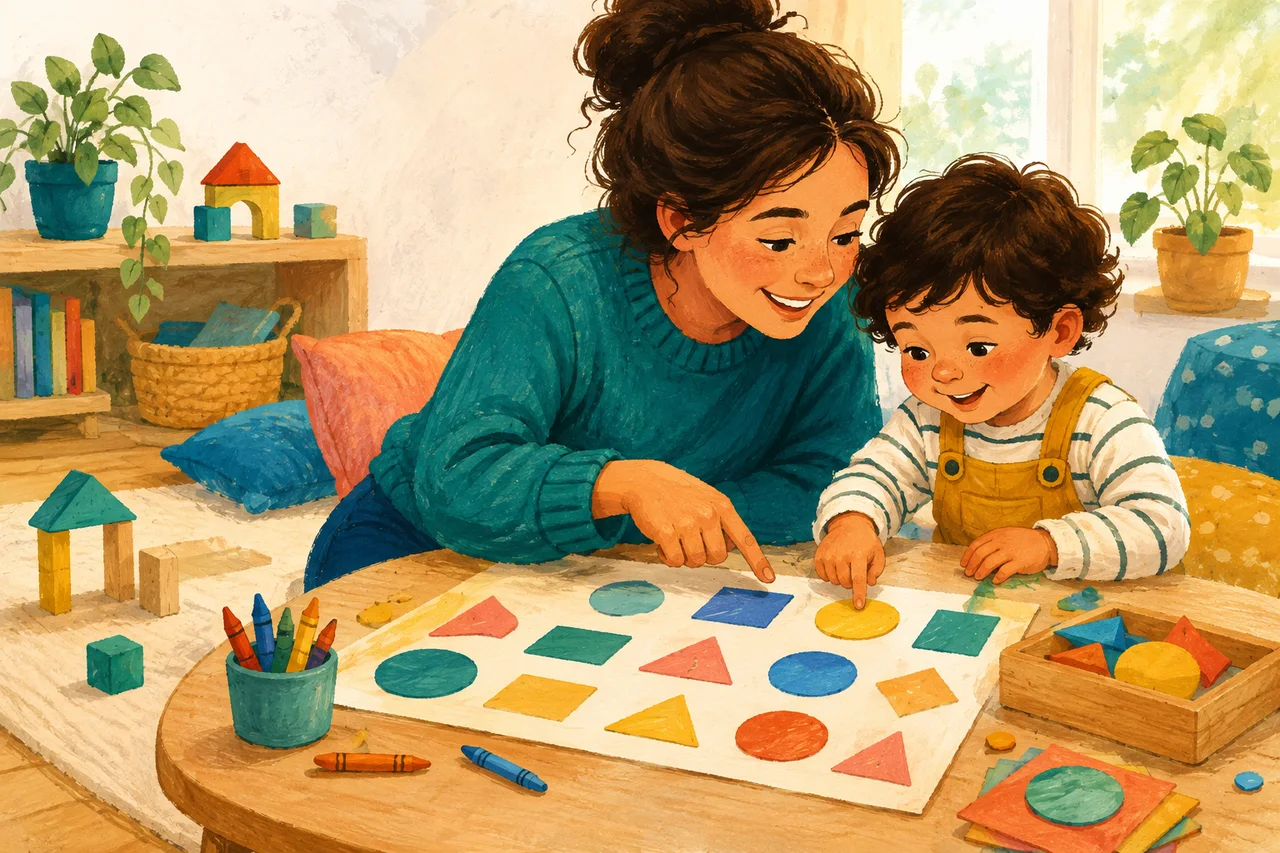
One child wants to race ahead; another is still exploring the materials. A shared game does not need identical tasks or equal speed. Try a colour hunt with three different jobs: choose, search and describe. No one has to be the best, and an adult remains responsible for helping both children.
Try this, step by step
Make a shared invitation
“Shall we find three blue things for our pretend shop?” Choose a small, safe area. Leave objects where they are if they are heavy, breakable or not safe to carry; pointing is enough.
Offer roles, not ranks
A chooser selects a colour card. A finder points to a matching object. A reporter describes one clue: “It is blue and soft.” A child can choose a role, share it with an adult or watch for a round.
Swap only when wanted
After one object, ask whether to keep the roles or change them. Do not make the older child explain every answer. If two children want the same job, they can find an object each or do separate short rounds.
Finish with a shared collection
Look at the three discoveries together. Compare shapes, textures or uses rather than who found more. Let each child choose one thing for an imaginary shop window, then return any objects you moved.
What it might sound like
- Child
- I want to pick the colour too!
- Adult
- You both want that job. We can each choose one colour, or use the same colour together.
- Child
- The same blue. I will find a soft thing.
- Adult
- I will help with the searching. Nobody has to teach the other person.
Make it fit your family
Joining through pointing or moving
Offer two large colour cards and let the child point. Finding one safe object, or noticing someone else’s find, can be their whole contribution.
Joining through describing or planning
Invite the child to invent a two-clue description: “blue and used for eating.” This is a different challenge, not a more important job.
When the shared plan is not working
Set up neighbouring versions: one child hunts for colours while the other arranges their finds. Keep adult attention available to both; separate play is a valid outcome.
You do not need to…
- Scoring the children against each other or making the younger child’s pace the older child’s responsibility.
- Insisting on sharing every object, taking turns on a rigid timer, or continuing after one child has had enough.
A warm way to finish
Ask, “What did you like about your job?” Each child may give a different answer. Name a shared moment — “We both noticed that the blue sock was soft” — without declaring a winner. Another day, the same invitation can have completely different roles.
One thing to remember
A shared goal can hold different tasks. Fair play does not have to mean identical play.
Try it together
These are play ideas, not a checklist or a developmental assessment. Change the plan or stop whenever your family needs to.