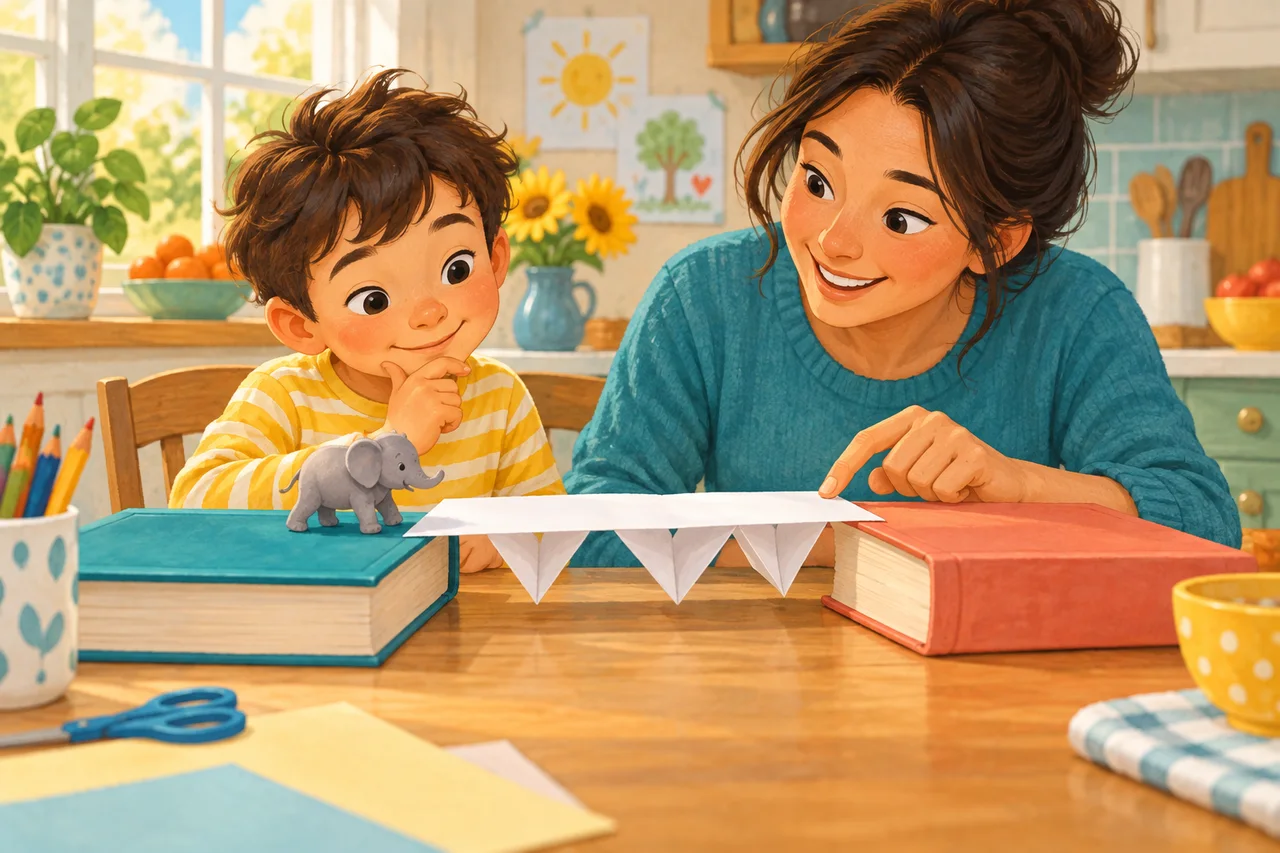
The paper bridge falls. Your child pushes the paper away: “I cannot do it!” You do not have to rescue the bridge immediately. First make room for the disappointment, then find out whether your child wants company, a hint or a break. The useful goal is not a perfect bridge; it is a next step your child can choose.
Try this, step by step
Pause before explaining
Put the materials down. Say what you saw without judging: “It fell just when you put the toy on.” Stay nearby; do not insist on an answer, eye contact or another attempt.
Offer a small, real choice
“Shall we leave it here, or try one change together?” Both choices must be possible. If your child wants help, ask whether to hold the paper or show one fold.
Change one thing
Move the supports closer OR fold the paper; do not change everything at once. Let the child choose the change and test the same light toy again. Compare the bridge with its previous version, not with someone else’s.
Notice the strategy
“This time you brought the supports closer.” If it falls again, you still have an observation. Put the pieces somewhere safe for later, or finish without a new attempt.
What it might sound like
- Child
- It is useless. It keeps falling!
- Adult
- You worked on it and it fell. That is disappointing. Would you like a pause or my hands to hold it?
- Child
- Hold this side.
- Adult
- I can hold it. You decide what we change.
Make it fit your family
A smaller next step
Offer two large pieces to choose from. You can hold the supports while the child places one sheet; watching is also a way to join in.
A child who wants more independence
Ask, “Would you like an idea, or time to think?” Wait for the answer. Agree on a place for unfinished work so stopping does not have to mean throwing it away.
When words feel like too much
Stay quiet and offer an open hand or a seat nearby. Leave explanations for another moment. You can return later with “Would you like to show me what happened?”
You do not need to…
- Calling the task easy or promising that the next try will definitely work.
- Finishing it secretly to make the result look successful, or making another attempt the price of a break.
A warm way to finish
“We found one thing to change. The bridge can wait; I liked being here with you.” Save a picture only if your child wants one. Nothing needs to be completed or ticked off today.
One thing to remember
Offer help in a form the child can choose. A pause is a real option, not a reward for trying harder.
Try it together
These are play ideas, not a checklist or a developmental assessment. Change the plan or stop whenever your family needs to.