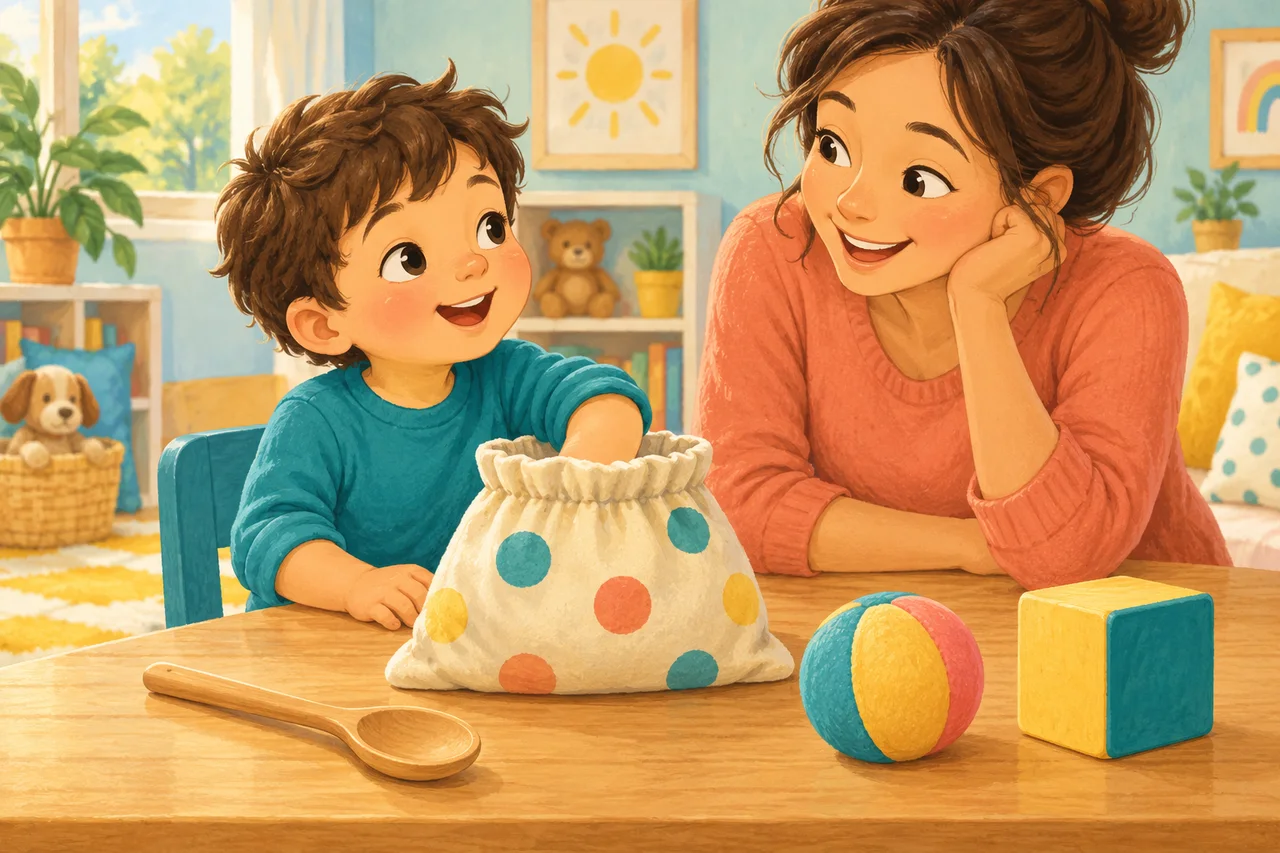
There are ten minutes before the next part of the day. You do not need to fit in a whole lesson. This plan turns three familiar, large, safe objects into a small guessing game. The times are an example for the adult, not a timer the child has to obey. Two enjoyable minutes can be the whole activity.
Try this, step by step
Minute 0–1: invite and choose
Ask, “Would you like a tiny guessing game, or shall I just tell you a funny story?” For the game, choose a clean cloth, a large cup and a soft toy. Skip bags with cords and objects that could fit in a child’s mouth. Sit where both of you are comfortable.
Minute 1–4: explore one object
An adult covers one object with the cloth. The child may feel it, ask for a clue or uncover it straight away. Try one description: soft, smooth, round or bendy. Keep the object hidden only while that is fun.
Minute 4–8: change one role
Invite the child to hide an object for you, or build a three-sentence story about it. “The cup wanted a hat. A cloth became its hat. The toy came to tea.” Ask for an idea without requiring an answer. One round is enough; you do not need all three objects.
Minute 8–10: close and put away
Offer one last look or one last sentence, then return the objects together. If the child wants to continue but you need to go, say what is possible: “I can hear one more clue, then I will put the cup away.” Do not promise a later game unless you can offer it.
What it might sound like
- Adult
- I have a small game. Would you like a clue, a look or a different idea?
- Child
- A look. No guessing.
- Adult
- A look it is. Here is the cup. What could it be in a funny story?
- Child
- A tiny house for the toy.
Make it fit your family
When energy is low
Leave the objects visible and tell the short story yourself. The child can choose the toy’s name or simply listen. No guessing is required.
When movement sounds better
Keep the objects in sight and ask the child to point from a comfortable place or carry one safe item to a pretend shop. Leave plenty of clear space; do not add a race.
When only two minutes are available
Choose one object, share one clue or one line of story, and finish warmly. Do not speed up the ten-minute plan to squeeze everything in.
You do not need to…
- Buying themed materials, filling every minute, or measuring success by how many answers were correct.
- Using food as hidden objects, putting a bag over a head, or leaving a young child alone with the materials.
A warm way to finish
“The cup became a tiny house! Shall we keep that idea in mind?” If you want, write the child’s own sentence in a private family note on the activity page. Saving is optional; the time together counts even when nothing is recorded.
One thing to remember
A small, finished moment of connection is enough. The plan can shrink to fit the day.
Try it together
These are play ideas, not a checklist or a developmental assessment. Change the plan or stop whenever your family needs to.